- 30 questionsin the guide's independent practice mock
- 25 minuteson the practice clock
- 24 correct answersthe guide's practice pass mark
- Rule 19keep it separate from rules for vessels in sightRule 19
The study focusWhat Second Mate (FG) revision means here
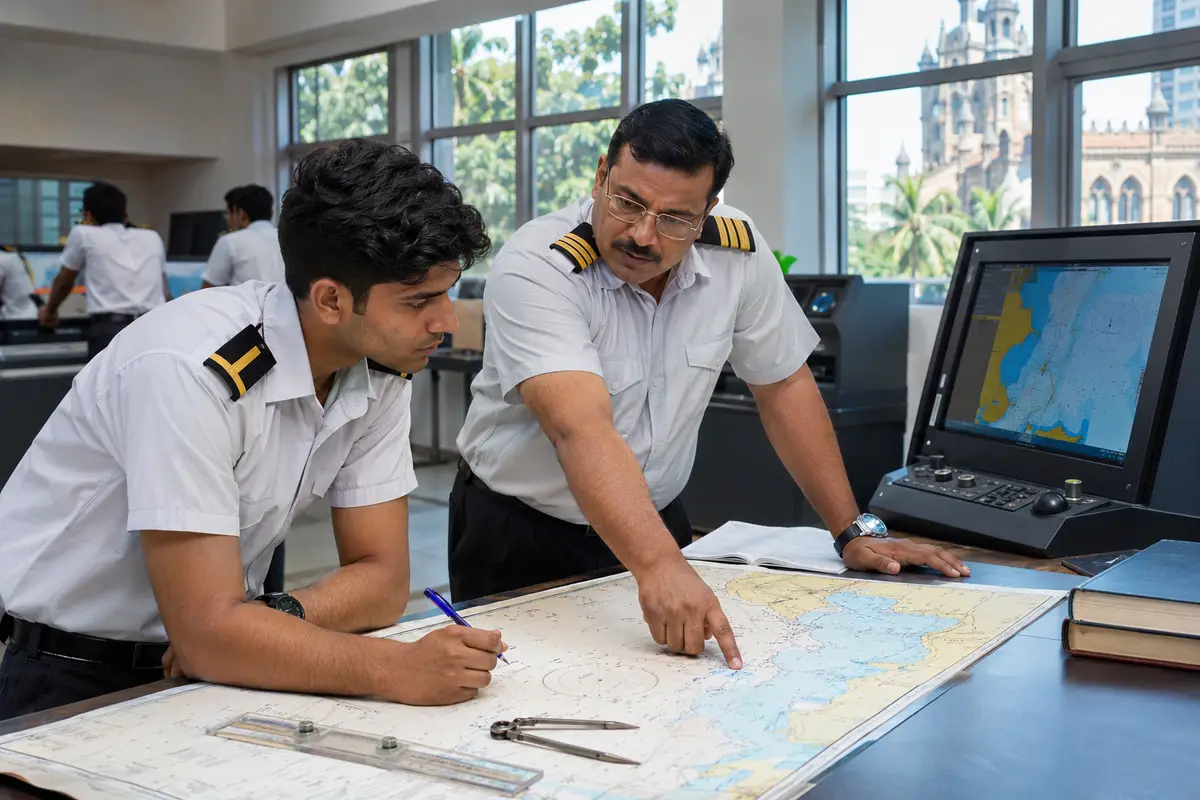
This is a revision guide for candidates studying towards Second Mate (Foreign Going) in India. Its focus is collision avoidance: linking each COLREG rule to the encounter, the lights and sound signals you observe, and the decision you would explain aloud. Use it for written revision and spoken question-and-answer practice alongside your approved course.

Use it wellWhat this guide helps you practise
Start with the foundations: lookout, safe speed, risk of collision and action to avoid collision. Then work through overtaking, head-on and crossing encounters. The useful habit is to explain why a rule applies, rather than simply recognise a remembered diagram.
With this guide, you can practise
- Using lights and shapes to identify a vessel's status
- Explaining the responsibilities between vessels
- Recognising manoeuvring, fog and restricted-visibility sound signals
- Identifying IALA marks with the direction of buoyage in mind
What it does not give you
- Official, recalled or complete Second Mate written or oral examination questions
- An official Second Mate result or a prediction of oral-examination success
- Official paper structure, oral-assessment procedure, time limits or pass marks
Before you beginWho this study guide is for
- Candidates studying towards Second Mate (Foreign Going) in India
- Learners who want to practise COLREG knowledge and explain their decisions aloud
- Candidates using the material alongside an approved course
- Learners who will confirm the current syllabus, eligibility and examination instructions with DG Shipping and their training provider
A practical routineHow to build a stronger answer
- Check your current instructions
Confirm the current syllabus, eligibility and examination instructions with DG Shipping and your training provider. Check [the applicable Merchant Shipping (Examination of Masters and Mates) Rules] with your provider too.
- Read the individual COLREG lessons
Use the rule lessons and printable summary for written revision. Give yourself time to understand the conditions of each rule before testing your recall.
- Train your recognition
Use the Lights & Shapes hub's 3D viewer, then revise manoeuvring and fog signals in the Sound Signals hub. Add IALA buoyage practice so that what you see and what you say stay connected.
- Say the answer aloud
Ask a partner to change the visibility, vessel status or encounter. State the relevant rule, explain why its conditions apply, then describe your action.
- Use the mock to target revision
Take the linked topic tests and unofficial mock. For every mistake, explain the rule and its application aloud before trying another question.
Keep the label clearThe practice mock is not the official examination
| Practice element | Guide setting |
|---|---|
| Questions | 30 questions |
| Clock | 25 minutes |
| Practice pass mark | 24 correct answers |
| Purpose | Choose what to revise; it is not an official result |
Our verdict
What works well
- It keeps revision anchored to COLREG rules and their conditions
- It combines written study with lights, shapes, sound signals and buoyage practice
- It encourages the spoken reasoning useful for question-and-answer practice
Keep in mind
- The questions are independent study prompts, not official or recalled questions
- The mock format is the guide's own setting, not the official examination format
- You still need to confirm current requirements with DG Shipping and your training provider
Use this guide to make your collision-avoidance explanations sharper, especially when a scenario changes and a memorised answer no longer fits. It is most useful beside your approved course, with current requirements confirmed directly with DG Shipping and your training provider.
Rules of the road and recognition practice
Free supporting practice questions
IALACOLREG Exam Pass
Second Mate: get ready for your exam with the Exam Pass
Unlimited timed mock exams, every mistake back until it's right, and a readiness score that shows when you're ready for the exam.
512 exam-style questions with explanations · 7 timed subject exams · every simulator scenario
One payment for 12 months, so it covers a resit too. No subscription.
Practice questions (with answers)
Emergency wreck marking buoys are used for:
Show answer
Correct answer: B. Marking new dangers, including newly discovered wrecks
The emergency wreck marking buoy marks new dangers, including newly discovered wrecks. The competent authority determines further marking once the danger is removed or its information has been sufficiently promulgated.
A vessel joining a traffic lane from the side should:
Show answer
Correct answer: B. Join at as small an angle as practicable to the traffic flow
Rule 10(b)(iii): when joining from the side, shall do so at as small an angle as practicable to the general direction of traffic flow.
Before she is finally past and clear, an overtaking vessel's bearing changes to resemble a crossing position. What is her duty?
Show answer
Correct answer: B. She remains the overtaking vessel and must keep clear
Rule 13(d): a later bearing change does not make the overtaking vessel a crossing vessel or relieve her duty until she is finally past and clear.
If in doubt whether a head-on situation exists:
Show answer
Correct answer: C. Assume it IS a head-on situation and alter to starboard
Rule 14(c): when in doubt, assume it IS a head-on situation and act accordingly.
Your power-driven vessel and another identified power-driven vessel are in sight in open water, crossing with risk of collision. She is on your starboard bow; neither is overtaking. Which duty applies to your vessel?
Show answer
Correct answer: B. Take early and substantial action to keep clear and, if circumstances admit, avoid crossing ahead
Rules 15 and 16 require your power-driven vessel to give way because the other power-driven vessel is crossing on your starboard side with risk of collision. A red sidelight alone would not establish vessel type or this duty.
The topmark of a West Cardinal mark is:
Show answer
Correct answer: C. Two cones point to point
Two separate black cones with their points facing each other. The cones must remain clearly separated.
You are entering a river where the chart shows the conventional direction of buoyage is upstream from the sea entrance. What should determine whether a lateral mark is port-hand or starboard-hand?
Show answer
Correct answer: C. The charted conventional direction of buoyage
Lateral marks are interpreted in the conventional direction of buoyage. The chart, not guesswork, determines which side is port-hand and which is starboard-hand.
You sight a cardinal mark with both cones pointing down and a light showing six quick flashes followed by one long flash. What is the safe action?
Show answer
Correct answer: C. Pass south of the mark
Two cones down and the 6+1 light rhythm identify a South Cardinal mark, meaning the safe water lies to the south of the mark.
The full guide
Prepare your Second Mate rules-of-the-road explanations by linking each COLREG rule to the encounter, vessel lights and sound signals you observe.
This independent guide supports Indian Second Mate (FG) candidates revising collision avoidance. Use it for written revision and spoken question-and-answer practice alongside your approved course.
Written revision: learn the rule and its conditions
Revise lookout, safe speed, risk of collision and action to avoid collision before practising overtaking, head-on and crossing encounters. Explain why a rule applies rather than choosing an answer from a remembered diagram. Keep rules for vessels in sight separate from Rule 19 in restricted visibility.
Use lights and shapes to identify a vessel's status, then review the responsibilities between vessels. Practise sound signals in their proper context, and identify IALA marks with the direction of buoyage in mind.
Second Mate orals COLREG questions: study prompts
Ask a partner: What would you check to assess risk of collision? Which rule applies to this crossing encounter? What do these lights indicate? What does this sound signal mean? State the rule, explain the conditions and describe the action. These are our revision prompts, not recalled or official DG Shipping examination questions.
Check DG Shipping's current instructions and the applicable Merchant Shipping (Examination of Masters and Mates) Rules with your training provider. This guide does not specify official paper structure, oral assessment procedure, time limits or pass marks.
Our practice format
The mock has 30 questions, a 25-minute clock and a practice pass mark of 24 correct answers. All three are our settings. Use your result to choose what to revise; it is not an official Second Mate result or a prediction of success in an oral examination.
Who this guide is for
For candidates studying towards Second Mate (Foreign Going) in India who want to practise COLREG knowledge and explain their decisions aloud. Confirm your current syllabus, eligibility and examination instructions directly with DG Shipping and your training provider.
How to use the free resources
Read the COLREG hub's individual rule lessons, then open its printable summary for the COLREG PDF. Use the Lights & Shapes hub's 3D viewer to practise recognition, Sound Signals to revise manoeuvring and fog signals, and IALA for buoyage. Take the linked topic tests and the unofficial mock. For each mistake, explain the rule and its application aloud before trying another question.
Free resources for your next study session
Second Mate COLREG study: questions
- Are these official DG Shipping Second Mate questions?
- No. These are independent lessons and study prompts. They are not an official, recalled or complete Second Mate written or oral question bank.
- How should I practise a COLREG oral answer?
- State the relevant rule, explain why its conditions apply, then describe your action. Practise with a partner who changes the visibility, vessel status or encounter so you have to reason through the answer.
- Which rules should I revise first?
- Begin with lookout, safe speed, risk of collision and action to avoid collision. Then study overtaking, head-on and crossing situations, responsibilities between vessels and restricted visibility using the individual rule lessons.
- How do I revise lights and sound signals?
- Use the linked Lights & Shapes hub's 3D viewer to identify a vessel's status. Review manoeuvring and restricted-visibility signals in the Sound Signals hub, then explain what each signal means before taking a practice test.
- Where can I find the COLREG PDF?
- The linked COLREG hub leads to the printable rules summary and PDF access. Use it as a revision aid alongside the rule lessons and your course materials.
- Is the mock the official Second Mate examination format?
- No. We use 30 questions, 25 minutes and 24 correct answers as our practice format. Confirm official examination requirements and the applicable rules directly with DG Shipping and your training provider.
Other exams
Reviewed by Ramon Curto, Nautical teacher at IECNPC · Last reviewed: