Lights & Shapes
COLREG 20(a,c) · U.S. Coast Guard — International Navigation Rules (2024): (a) Rules in this part shall be complied with in all weathers. (c) The lights prescribed by these Rules shall, if carried, also be exhibited from sunrise to sunset in restricted visibility and may be exhibited in all other circumstances when it is deemed necessary.
Lights & Shapes — Cheat Sheet
Study selected light and day-shape configurations from Rules 23–30. Compare the four aspects and check the vessel type, length and operating condition against the rule. A visible pattern alone may fit more than one situation.
Lights and shapes by vessel type (Rules 20–31)
- COLREG Rule 233D
Power-driven Vessels Underway
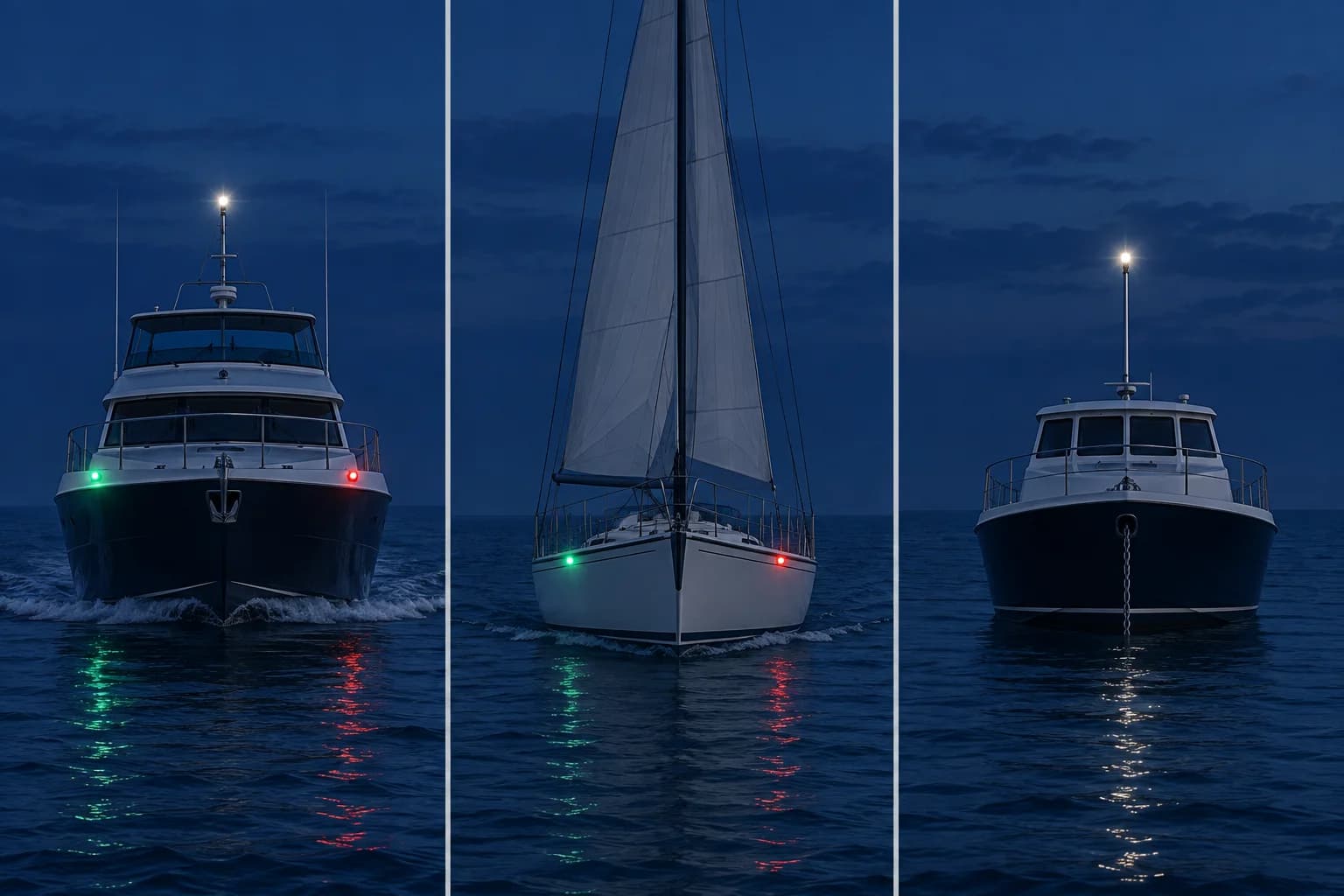
Power-driven vessels underway shall exhibit masthead light(s), sidelights, and sternlight. Vessels 50m+ require two masthead lights.
- COLREG Rule 243D
Towing and Pushing
Vessels towing or pushing display additional masthead lights and a yellow towing light. Three masthead lights if tow exceeds 200m.
- COLREG Rule 253D
Sailing Vessels Underway and Vessels Under Oars
Sailing vessels show sidelights and sternlight. May optionally show red over green all-round lights at the masthead.
- COLREG Rule 263D
Fishing Vessels
Fishing vessels show green over white when trawling, red over white for other fishing, and sidelights plus sternlight when making way.
- COLREG Rule 273D
Vessels Not Under Command or Restricted in Ability to Manoeuvre
NUC shows two red all-round lights vertically. RAM shows red-white-red all-round lights vertically.
- COLREG Rule 283D
Vessels Constrained by Their Draught
A vessel constrained by draught may display three all-round red lights in a vertical line, or a cylinder day shape.
- COLREG Rule 293D
Pilot Vessels
A pilot vessel on duty shows white over red all-round lights at the masthead. When underway, also sidelights and sternlight.
- COLREG Rule 303D
Anchored Vessels and Vessels Aground
Anchored vessels show an all-round white light forward and another aft (lower). Vessels aground additionally show two red all-round lights.
- COLREG Rule 313D
Seaplanes
Where it is impracticable for a seaplane to exhibit lights of the exact characteristics, it shall exhibit lights as closely similar as possible.
- COLREG Rule 20Application (Lights)Rules concerning lights shall be complied with from sunset to sunrise and during restricted visibility.
- COLREG Rule 21Definitions (Lights)Defines masthead light, sidelights, sternlight, towing light, all-round light and flashing light.
- COLREG Rule 22Visibility of LightsSpecifies minimum visibility ranges for lights based on vessel length.
Reading vessel lights — the framework that actually works
COLREG 21(a,b,c) · U.S. Coast Guard — International Navigation Rules (2024)
(a) Masthead light means a white light placed over the fore and aft centerline of the vessel showing an unbroken light over an arc of the horizon of 225° and so fixed as to show the light from right ahead to 22.5° abaft the beam on either side of the vessel.
(b) Sidelights means a green light on the starboard side and a red light on the port side each showing an unbroken light over an arc of the horizon of 112.5° and so fixed as to show the light from right ahead to 22.5° abaft the beam on its respective side.
In a vessel of less than 20 m in length the sidelights may be combined in one lantern carried on the fore and aft centerline of the vessel.
(c) Sternlight means a white light placed as nearly as practicable at the stern showing an unbroken light over an arc of the horizon of 135° and so fixed as to show the light 67.5° from right aft on each side of the vessel.
Day shapes: one ball indicates a vessel at anchor (Rule 30); two balls vertically indicate not under command (27); three balls vertically indicate aground (30). A cylinder is the optional shape for a vessel constrained by draught (28). Apply each rule’s conditions and small-vessel exemptions.
Rules 23–31 cover specific vessel categories: power-driven (23), towing and pushing (24), sailing and rowing (25), fishing (26), NUC and RAM (27), constrained by draught (28), pilot (29), anchored and aground (30), seaplanes and WIG (31).
Study selected light and day-shape configurations from Rules 23–30. Compare the four aspects and check the vessel type, length and operating condition against the rule. A visible pattern alone may fit more than one situation.
Fastest routes through the lights syllabus
- Lights & shapes cheat sheetStudy selected light and day-shape configurations from Rules 23–30. Compare the four aspects and check the vessel type, length and operating condition against the rule. A visible pattern alone may fit more than one situation.
- Study by images (3D)Browse vessel types with fixed-aspect 3D models and matching 2D light diagrams.
- Test by imagesA vessel appears with no label — identify which COLREG variant it is from its lights.
- Sound signals (Part D)Whistle, bell and fog signals — the audible companion to the visual rules.