- 16minimum age to start
- By daythe practical certificate is for daylight skippering
- Familiar waterswhere the qualification prepares you to skipper
- Sail or motorseparate versions let you choose your route
- Coastala natural fit for cruising-yacht passages
- Voluntarya qualification you choose to take
The essential ideaWhat is RYA Day Skipper?
RYA Day Skipper is a pathway that combines shorebased knowledge with practical training to help you skipper a small yacht by day in familiar waters. The RYA Day Skipper Practical certificate is voluntary, and you can take a separate sail or motor version. It is aimed at yachtsmen and women who want to skipper a cruising yacht on coastal passages by day.
Your working watersA qualification with a clear daytime focus
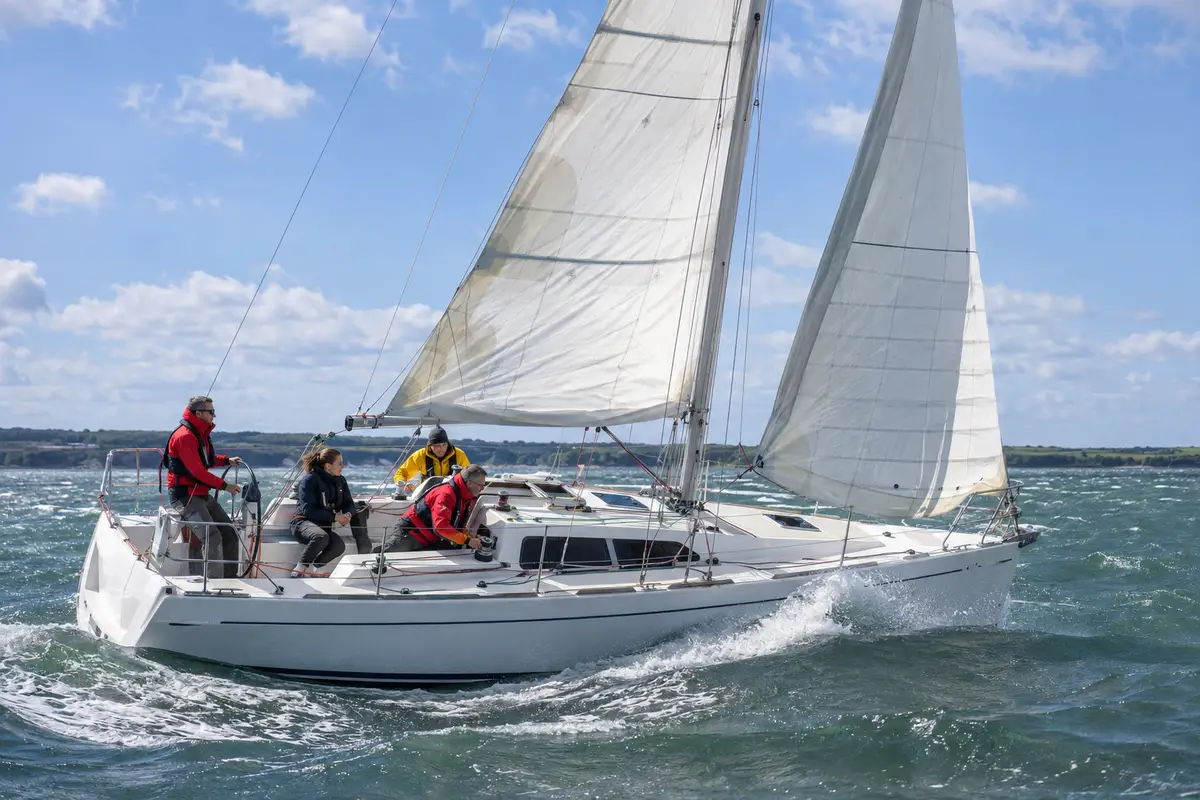
This is preparation for skippering in familiar waters by day. Navigation, seamanship, safety and passage planning sit alongside the practical assessment in the full RYA course programme. Choose the version that matches the kind of boat you want to skipper, because sail and motor are separate routes.
Day Skipper prepares you to
- Skipper in familiar waters by day
- Work towards coastal passages on a cruising yacht by day
- Take either the separate sail version or the separate motor version
Keep in mind
- It is not one combined sail-and-motor version; you choose a separate route
- Its stated focus is daytime skippering in familiar waters
- It is a voluntary qualification
Before you beginStarting point
- Be at least 16 years old
- Choose whether you want the separate sail or motor version
- Be ready to follow the full RYA course programme for navigation, seamanship, safety and practical assessment
The route throughHow to prepare
- Choose sail or motor
Start by choosing the separate version that fits the boat you want to skipper.
- Revise the rules that keep you clear
Use the lessons to revise collision avoidance, buoyage, lights and signals.
- Build the navigation picture
Work through chart work, tides, safety and passage planning alongside COLREG 1972, IALA buoyage, lights and day shapes, and sound signals.
- Follow the full RYA programme
Bring navigation, seamanship, safety and practical assessment together through the full RYA course programme.
Our verdict
Why it works
- It combines shorebased knowledge with practical training
- Its focus on familiar waters by day is clear and useful
- Separate sail and motor versions let you follow the route that suits your boating
What to watch
- You need to choose between the separate sail and motor versions
- The stated focus is daytime skippering in familiar waters
- You still need to cover navigation, seamanship, safety and practical assessment
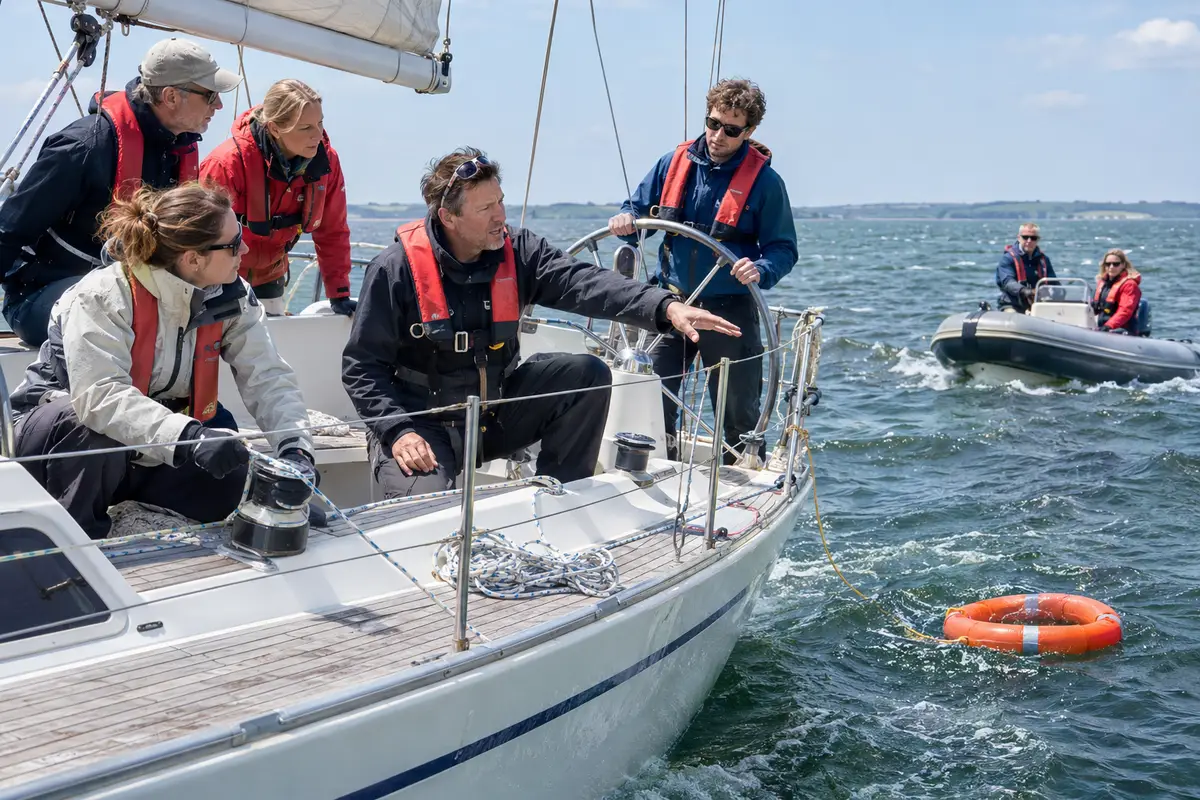
Choose RYA Day Skipper if your ambition is to take charge of a cruising yacht on coastal passages by day, with familiar waters as your base. The pathway combines practical training with navigation, seamanship and safety knowledge.
Topics tested by RYA Day Skipper
Practice tests aligned with RYA Day Skipper
IALACOLREG Exam Pass
RYA Day Skipper: get ready for your exam with the Exam Pass
Unlimited timed mock exams, every mistake back until it's right, and a readiness score that shows when you're ready for the exam.
512 exam-style questions with explanations · 7 timed subject exams · every simulator scenario
One payment for 12 months, so it covers a resit too. No subscription.
Practice questions (with answers)
For a vessel of 50m or more, the masthead light must be visible at:
Show answer
Correct answer: C. 6 nautical miles
Rule 22: masthead light of vessels 50m+ must be visible at a minimum of 6 nautical miles.
Emergency wreck marking buoys are used for:
Show answer
Correct answer: B. Marking new dangers, including newly discovered wrecks
The emergency wreck marking buoy marks new dangers, including newly discovered wrecks. The competent authority determines further marking once the danger is removed or its information has been sufficiently promulgated.
Section I of Part B (Rules 4–10) — look-out, safe speed, risk of collision, action to avoid collision — applies:
Show answer
Correct answer: B. In any condition of visibility, day or night
Rule 4 applies Section I in any condition of visibility. Rule 11 limits Section II to vessels in sight of one another. Rule 19 applies to vessels not in sight when navigating in or near restricted visibility.
Which is a clear violation of the look-out requirement?
Show answer
Correct answer: B. Assigning the look-out person administrative paperwork during the watch
A proper look-out must be able to give full attention to the task. Assigning unrelated duties that distract the watch violates the rule.
For vessels with operational radar, safe speed must additionally consider:
Show answer
Correct answer: B. Characteristics and limitations of radar equipment
Rule 6(b) applies to vessels with operational radar and requires consideration of its characteristics, efficiency and limitations, among other radar-related factors.
The topmark of a West Cardinal mark is:
Show answer
Correct answer: C. Two cones point to point
Two separate black cones with their points facing each other. The cones must remain clearly separated.
You are entering a river where the chart shows the conventional direction of buoyage is upstream from the sea entrance. What should determine whether a lateral mark is port-hand or starboard-hand?
Show answer
Correct answer: C. The charted conventional direction of buoyage
Lateral marks are interpreted in the conventional direction of buoyage. The chart, not guesswork, determines which side is port-hand and which is starboard-hand.
You sight a cardinal mark with both cones pointing down and a light showing six quick flashes followed by one long flash. What is the safe action?
Show answer
Correct answer: C. Pass south of the mark
Two cones down and the 6+1 light rhythm identify a South Cardinal mark, meaning the safe water lies to the south of the mark.
The full guide
The RYA Day Skipper pathway combines shorebased knowledge with practical training to skipper a small yacht by day in familiar waters.
Syllabus: COLREG 1972, IALA buoyage, lights and day shapes, sound signals, chart work, tides, safety, passage planning.
Who should take the RYA Day Skipper
Yachtsmen and women who want to skipper a cruising yacht on coastal passages by day.
How to prepare
Use these lessons to revise collision avoidance, buoyage, lights and signals. Follow the full RYA course programme for navigation, seamanship, safety and practical assessment.
Other exams
Reviewed by Ramon Curto, Nautical teacher at IECNPC · Last reviewed: