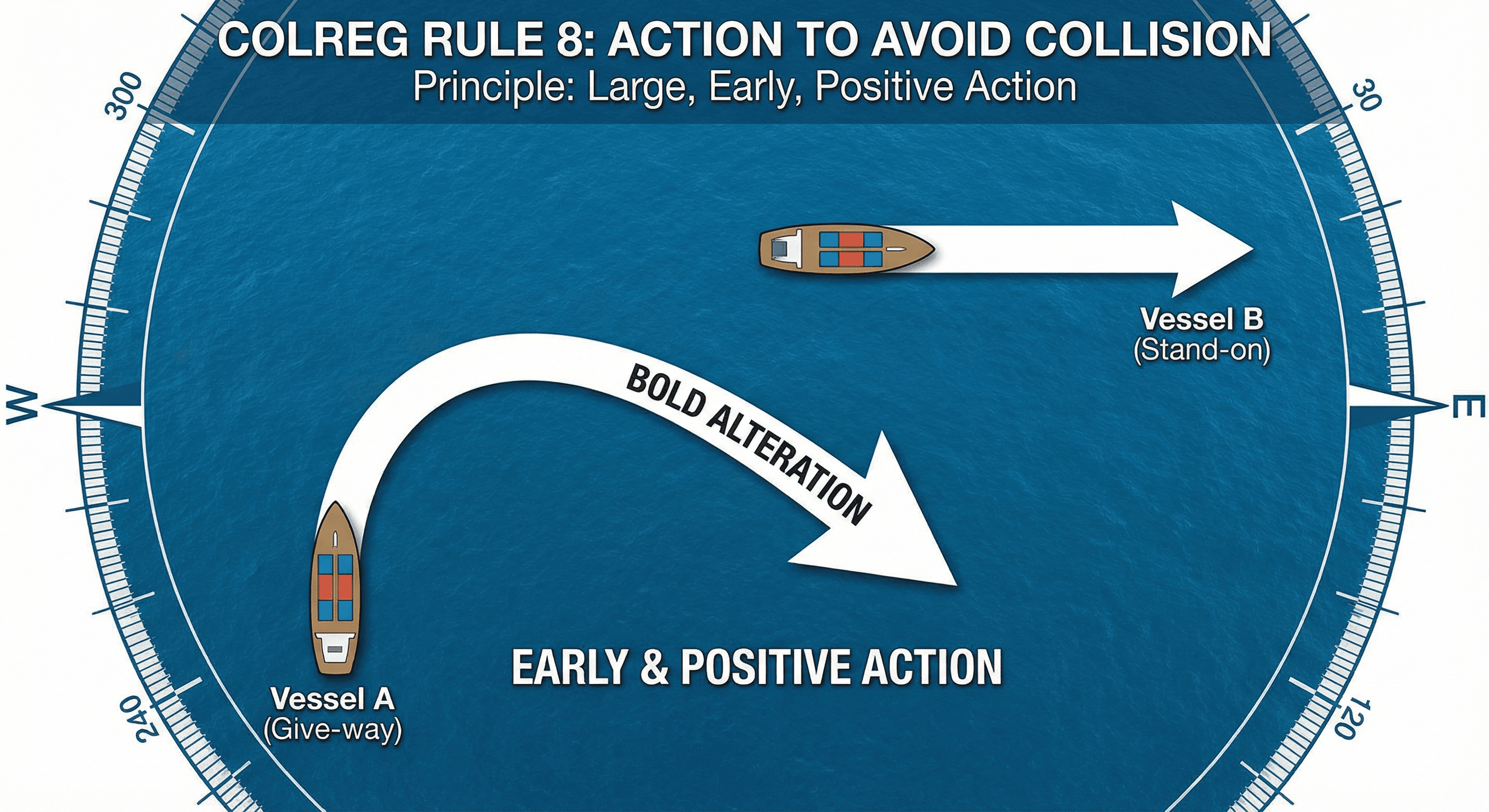
Rule 8: Action to avoid collision
Avoiding action must be early, clear, substantial and monitored until finally past and clear.
Detailed Explanation
This rule explains how to manoeuvre correctly:
(a) Action must follow Part B and, when possible, be positive, timely, and seamanlike.
(b) Alterations of course/speed should be large enough to be obvious visually and by radar; avoid multiple small changes.
(c) With enough sea room, course alteration alone can be most effective if early/substantial and without creating a new close-quarters risk.
(d) Action must produce safe passing distance, and effectiveness must be checked until finally past and clear.
(e) If needed, slow, stop, or reverse propulsion to buy time and space.
(f) For vessels required not to impede: (i) act early to provide sea room; (ii) obligation continues even when risk develops; (iii) the vessel not to be impeded still has full Rule obligations when risk exists.
Key Points
- Action must be early, large and obvious
- Avoid a series of small alterations
- Monitor effect until finally past and clear
- Speed reduction alone can be effective action
Examples
- You are give-way in a crossing situation. You alter 40° to starboard — a large, readily apparent change per Rule 8(b) — and monitor ARPA to confirm CPA is improving.
- After altering course for a fishing fleet, you track the closest vessel on radar and verify your CPA has opened to 1.5 miles. Rule 8(d) requires checking until finally past and clear.
- A container ship makes a 5° course change that the other vessel cannot detect on radar. This violates Rule 8(b): the alteration must be large enough to be readily apparent.
Common Mistakes
- Making a series of small course changes that are not readily apparent to the other vessel.
- Failing to verify that the manoeuvre is actually achieving a safe CPA before considering the situation resolved.
- Reducing speed so slightly that the other vessel cannot detect the change on radar.