Part B-ICritical
Rule 6: Safe speed
Safe speed is the speed that still lets you avoid collision effectively and stop in time.
Detailed Explanation
Safe speed is not a fixed number; it is context-driven.
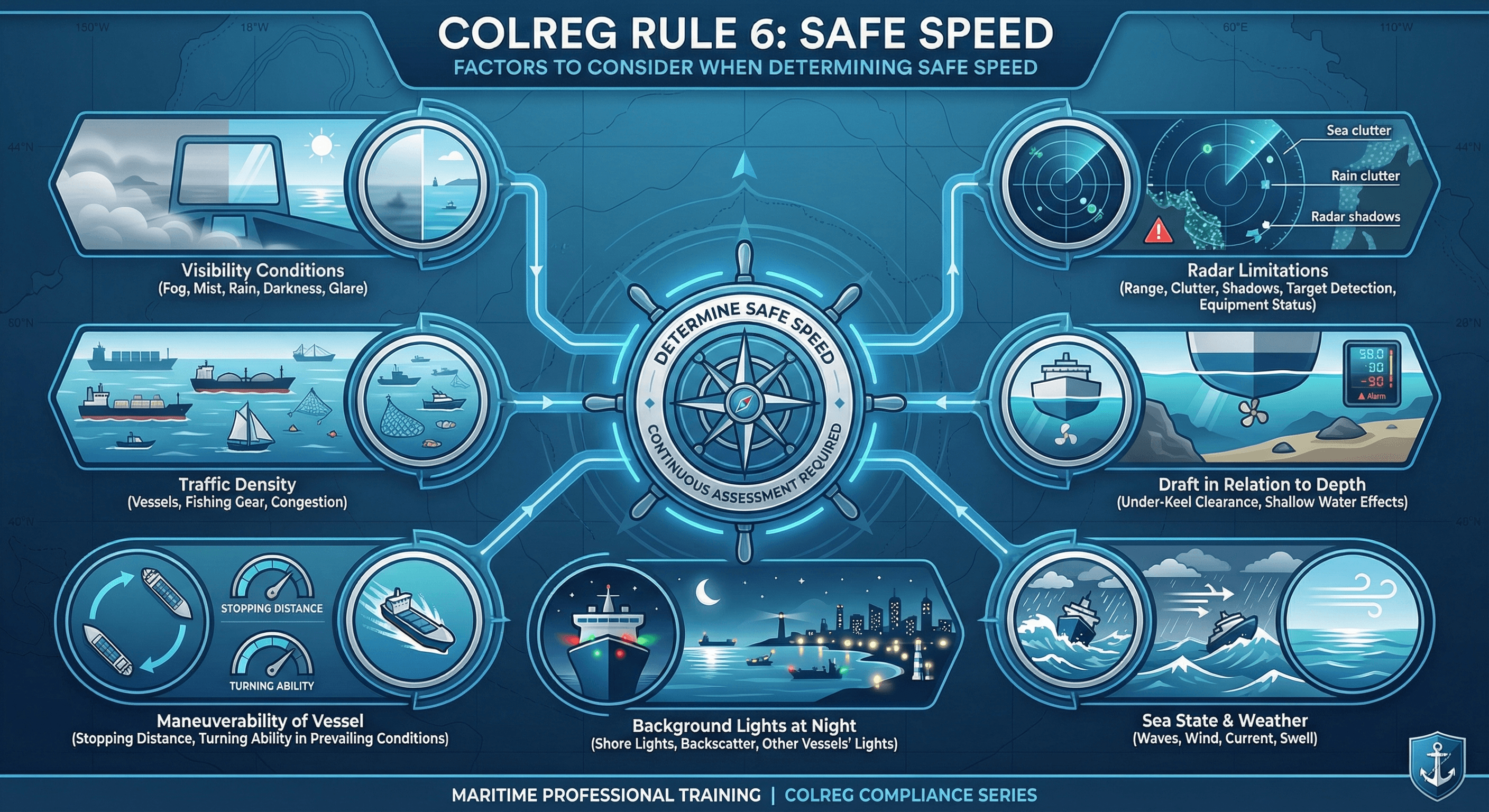
(a) For all vessels consider: (i) visibility; (ii) traffic density; (iii) manoeuvrability (stopping/turning); (iv) background light at night; (v) wind/sea/current and nearby hazards; (vi) draught versus available depth.
(b) With operational radar also consider: (i) radar limits; (ii) scale constraints; (iii) sea/weather/interference effects; (iv) possible missed detection of small targets/ice/objects; (v) number/location/movement of targets; (vi) improved visibility assessment by radar ranging.
Key Points
- Safe speed is situational, not a fixed number
- Radar never justifies maintaining excess speed
- Evaluate all six factors in (a) and six radar factors in (b)
- Must be able to stop in time for the prevailing conditions
Examples
- Your bulk carrier draws 14 m in a channel with 16 m charted depth. You reduce to 8 knots because Rule 6 requires you to factor draught-to-depth ratio into your safe speed assessment.
- At night near a fishing fleet with strong background shore lights, you slow to 10 knots because Rule 6(a)(iii) lists background light interference as a factor in determining safe speed.
- A ferry master argues the radar justifies 18 knots in fog. The pilot disagrees: Rule 6(a)(ii) says traffic density must be considered, and radar alone never justifies excess speed.
Common Mistakes
- Assuming 'safe speed' means a fixed value in knots instead of evaluating all factors in (a) and (b).
- Maintaining full sea speed in fog because 'the radar is clear'.
- Ignoring the six radar-specific factors in Rule 6(b) when radar is fitted.