Part B-ICritical
Rule 7: Risk of collision
Use every available method to detect collision risk early; if unsure, treat it as risk.
Detailed Explanation
Rule 7 is about disciplined assessment.
(a) Use all available means to determine collision risk. If doubt exists, risk exists.
(b) If radar is fitted and operational, use it properly: long-range scan, plotting or equivalent systematic tracking.
(c) Never assume safety from scant information, especially scant radar data.
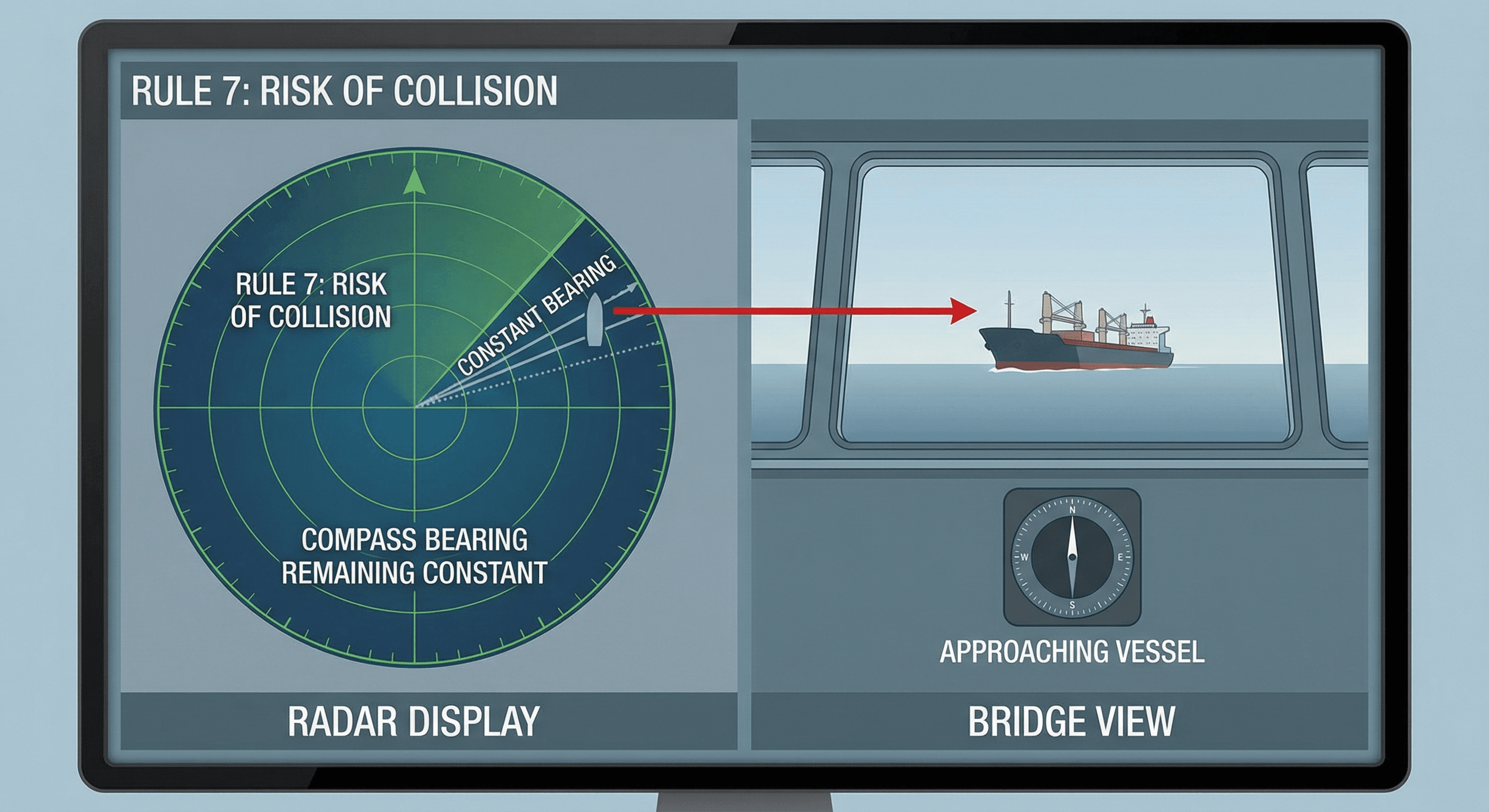
(d) Key cues: (i) if bearing does not appreciably change, risk is deemed to exist; (ii) risk may still exist even with bearing change, especially with very large vessels, tows, or close range.
Key Points
- Use every available means to assess risk of collision
- Constant bearing + decreasing range = collision risk
- Doubt about risk → treat as if risk exists
- Do not rely on scanty radar information alone
Examples
- You track a vessel on radar: bearing 045° steady for 10 minutes, range closing from 8 to 5 miles. Constant bearing plus decreasing range means risk of collision exists under Rule 7(d)(i).
- At night you see a white light and green sidelight steady on bearing 020°. The bearing is not changing — treat as risk of collision per Rule 7(a).
- A single radar target appears at 12 miles but no ARPA vector is available yet. Rule 7(b) says you must not make assumptions based on scanty information — you begin manual plotting immediately.
Common Mistakes
- Assuming no risk exists because a vessel is still far away, without checking bearing change.
- Making assumptions based on scanty radar information, violating Rule 7(c).
- Forgetting that risk may exist even with an appreciable bearing change for large or nearby vessels.