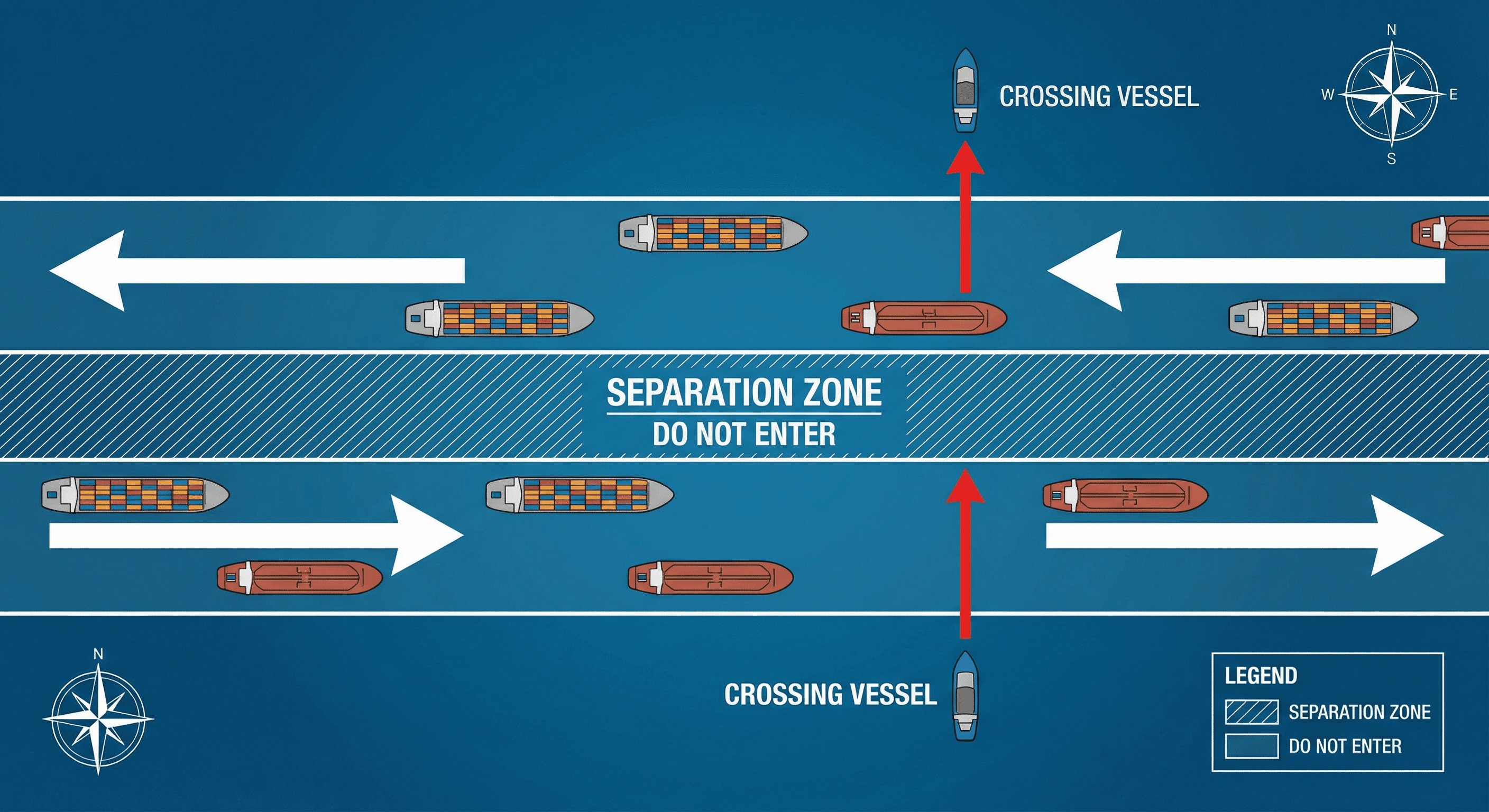
Rule 10: Traffic separation schemes
In TSS, follow lane logic strictly and avoid impeding organized traffic flow.
Detailed Explanation
(a) Applies to IMO-adopted TSS and does not cancel other Rules.
(b) If using TSS: (i) proceed in correct lane direction; (ii) keep clear of separation line/zone as far as practicable; (iii) normally join/leave at lane ends, or with small angle from the side.
(c) Avoid crossing lanes; if obliged, cross as nearly at right angles as practicable.
(d) Do not use inshore traffic zone when lane can be safely used, except permitted categories and route/danger exceptions.
(e) Do not normally enter separation zone/cross separation line except emergency or fishing within zone.
(f) Near terminations, navigate with particular caution.
(g) Avoid anchoring in TSS or near terminations.
(h) If not using TSS, avoid it by as wide a margin as practicable.
(i) Fishing vessels shall not impede lane-following vessels.
(j) Vessels <20 m and sailing vessels shall not impede safe passage of power-driven lane followers.
(k) RAM vessel maintaining navigation safety in TSS is exempt to extent necessary.
(l) RAM vessel laying/servicing/picking submarine cable in TSS is exempt to extent necessary.
Key Points
- Follow lane direction; cross at right angles
- Do not impede vessels using the traffic lane
- Join/leave at lane ends or at small angle to flow
- Inshore traffic zone: only for local traffic, <20m, sailing, fishing
Examples
- Your fishing trawler needs to cross a TSS. Rule 10(c) requires you to cross at as near to right angles as practicable, minimizing the time you spend in the traffic lane.
- A 15 m sailing yacht enters the inshore traffic zone rather than the main lane. Under Rule 10(d), vessels under 20 m and sailing vessels may use the inshore zone but must not impede through traffic.
- You are joining a TSS from port. Rule 10(b)(iii) directs you to join the lane at as small an angle as practicable, ideally at the lane end, to merge smoothly with the traffic flow.
Common Mistakes
- Crossing a TSS at an oblique angle instead of nearly at right angles to the traffic flow.
- Joining a traffic lane at right angles instead of at the lane ends or at as small an angle as practicable.
- A fishing vessel believing its gear in the water exempts it from the duty not to impede through-traffic in the lane.