Part B-IICritical
Rule 17: Action by stand-on vessel
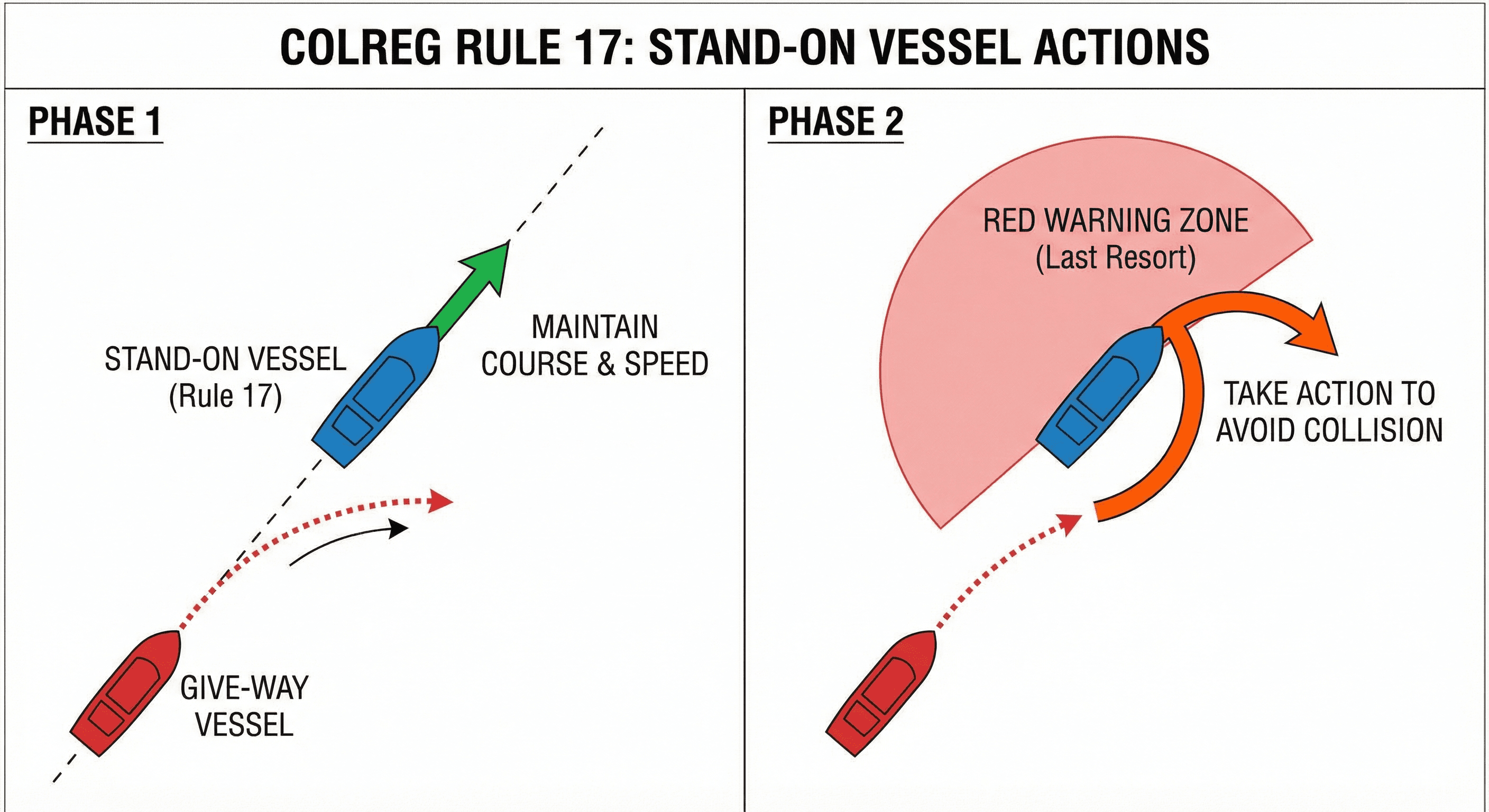
Stand-on vessel maintains course/speed initially, but must intervene if safety requires it.
Detailed Explanation
(a)(i) Stand-on vessel keeps course and speed.
(a)(ii) She may manoeuvre alone as soon as it is apparent give-way vessel is not taking appropriate action.
(b) If collision cannot be avoided by give-way action alone, stand-on vessel shall take best action to avoid collision.
(c) In crossing, a power-driven stand-on vessel acting under (a)(ii) should, if possible, avoid altering to port for a vessel on her own port side.
(d) Give-way vessel is never relieved of her obligation.
Key Points
- Stand-on: maintain course and speed initially
- May act when give-way vessel is not taking action
- Shall act when collision cannot be avoided by give-way alone
- Avoid altering to port for a vessel on your port side
Examples
- You are stand-on in a crossing. The give-way vessel at 3 miles has not altered course. Under Rule 17(a)(ii), you may now take action to avoid collision by your own manoeuvre alone.
- A cargo ship is stand-on and the crossing give-way vessel is closing without action. At 1 mile, collision cannot be avoided by the give-way vessel alone. Under Rule 17(b), the stand-on vessel shall take such action as will best aid to avoid collision — but avoids altering to port for a vessel on her port side.
Common Mistakes
- Stand-on vessel altering course immediately instead of maintaining course and speed per subsection (a)(i).
- Altering to port for a crossing vessel on the port side, violating subsection (c).
- Believing stand-on status means no obligation to act even when collision is imminent.