Part B-IICritical
Rule 14: Head-on
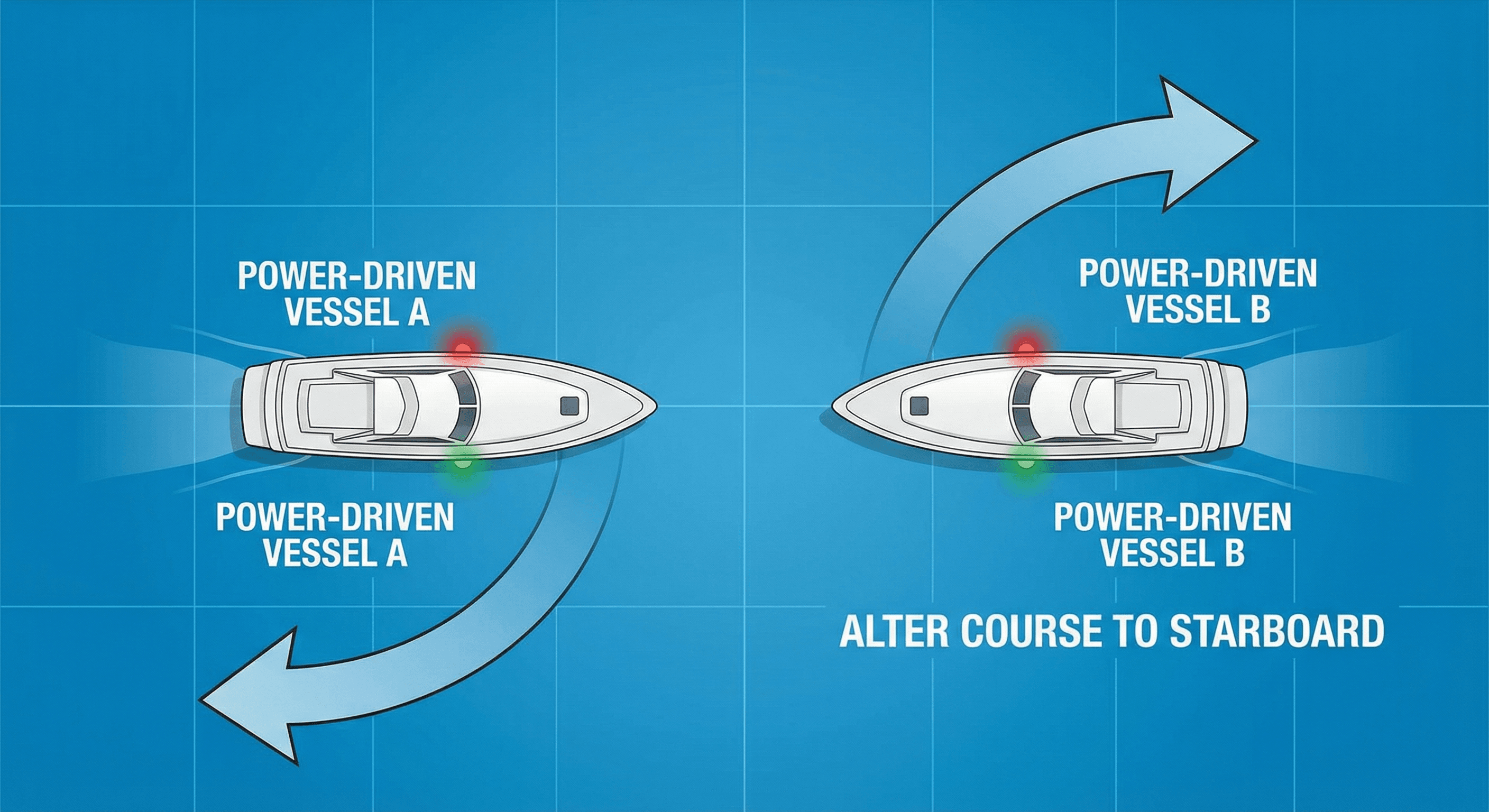
Head-on between power-driven vessels: both alter to starboard and pass port-to-port.
Detailed Explanation
(a) On reciprocal or nearly reciprocal courses with collision risk, both power-driven vessels alter to starboard.
(b) Deemed head-on when one sees the other ahead/nearly ahead and, by night, masthead lights in or nearly in line and/or both sidelights (or corresponding daytime aspect).
(c) In doubt, treat as head-on and act accordingly.
Key Points
- Head-on: both vessels alter to starboard
- Doubt → assume head-on and alter to starboard
- Applies when seeing masthead lights in line + both sidelights
- Port to port passing is the default in head-on
Examples
- At night you see both sidelights and two masthead lights of a vessel nearly dead ahead on a reciprocal course. This is a head-on situation under Rule 14 — both vessels alter to starboard to pass port-to-port.
- You see a vessel bearing 002° showing both sidelights and masthead lights. You are uncertain whether this is head-on or a fine crossing. Rule 14(c) says if in doubt, assume head-on and alter to starboard.
Common Mistakes
- Altering to port in a head-on situation instead of starboard.
- Treating a fine angle approach as a crossing situation when it is actually head-on.
- Waiting to confirm the situation beyond doubt instead of assuming head-on per Rule 14(c).