- 24 mmaximum motorboat lengthBOE — Real Decreto 875/2014: recreational qualifications, consolidated text
- 150 nautical milesmaximum distance from shoreBOE — Real Decreto 875/2014: recreational qualifications, consolidated text
- 40 questionsin the theory examinationDirección General de la Marina Mercante / BOE — 2026 recreational examinations; Annex III marking criteria
- 2 hoursto complete the examinationDirección General de la Marina Mercante / BOE — 2026 recreational examinations; Annex III marking criteria
- 48 hoursof boat practice, including day and night watchesBOE — Real Decreto 875/2014: recreational qualifications, consolidated text
- From 18minimum ageBOE — Real Decreto 875/2014: recreational qualifications, consolidated text
The next horizonWhat is Patrón de yate?
Patrón de yate is a Spanish recreational qualification for skippers who already hold the Patrón de embarcaciones de recreo, or PER. It lets you take motorboats up to 24 metres as far as 150 nautical miles from shore. Add the complementary training and you can sail too.
Your operating groundWhat you can command, and where
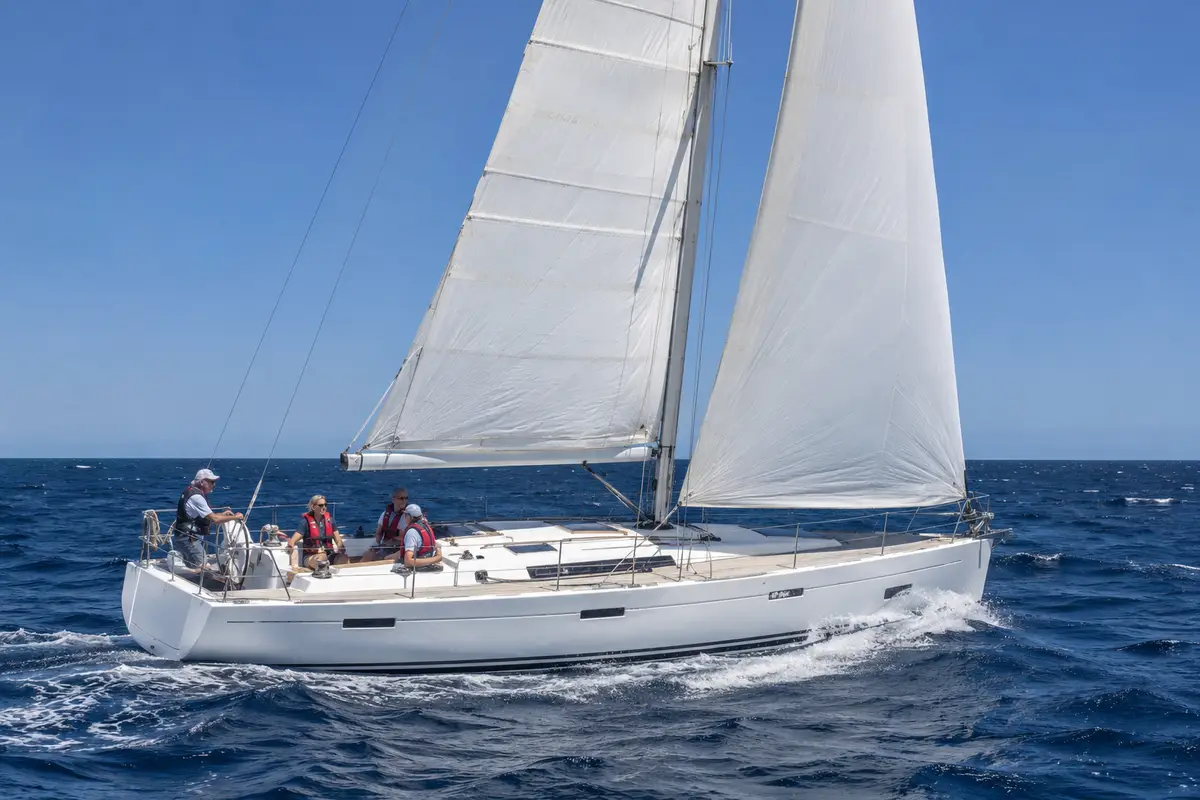
The headline is simple: 24 metres of motorboat and 150 nautical miles from shore. That is a marked change of scale from the PER, and it is why the course puts navigation theory, chart navigation, meteorology and safety at sea at the centre of the syllabus.
With Patrón de yate, you can
- Use motorboats up to 24 metres
- Navigate up to 150 nautical miles from shore
- Sail when you have completed the complementary sailing training
The limits to keep in view
- Do not take a motorboat longer than 24 metres under this qualification
- Do not navigate more than 150 nautical miles from shore under this qualification
- Do not sail without the complementary sailing training
Before you beginWhat you need
- Be at least 18 years old
- Already hold the Patrón de embarcaciones de recreo, or PER
- Complete an SRC course
- Complete at least 48 hours of boat practice with day and night watches
A practical routeHow to get Patrón de yate
- Start with your PER
Patrón de embarcaciones de recreo, or PER, is the prior recreational boat skipper title required for Patrón de yate.
- Prepare the theory
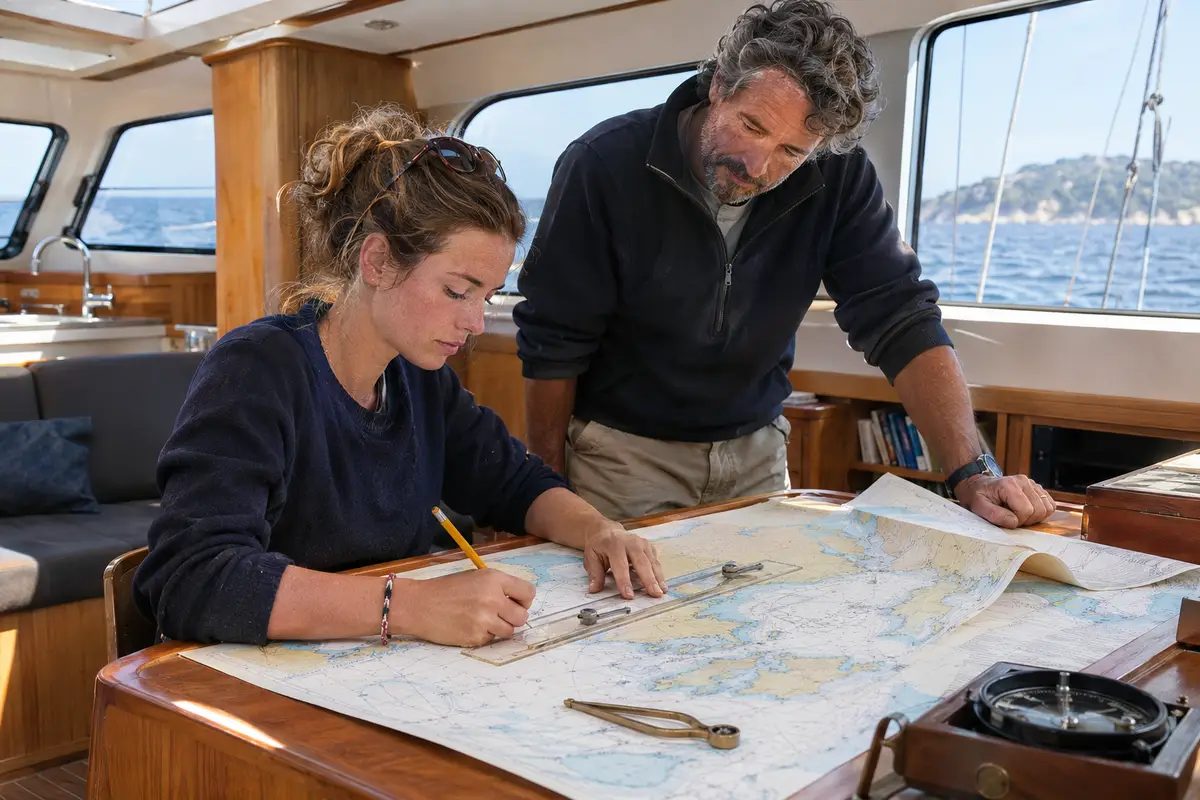
Work through safety at sea, meteorology, navigation theory and chart navigation, with COLREG and buoyage remaining essential seamanship knowledge.
- Pass the examination
Answer 40 questions in 2 hours and score at least 28 overall. The examination also sets separate limits for navigation-theory and chart errors, and has a modular option.
- Build your time afloat
Complete at least 48 hours of boat practice, including day and night watches.
- Complete the SRC course
An SRC course is also required alongside the practical training and examination.
At the deskThe theory examination at a glance
| Part | What to expect |
|---|---|
| Format | 40 questions in 2 hours |
| Overall pass | At least 28 correct answers |
| Navigation theory | No more than 5 errors |
| Chartwork | No more than 3 errors |
| Option | A modular option is available |
The Spanish ladderWhere Patrón de yate sits among Spain's recreational licences
- Licencia de navegaciónby day, from a port, marina or shelter
- Patrón para navegación básicafrom a port, marina or shelter
- Patrón de embarcaciones de recreo24 metres with extra practice
- Patrón de yatefrom shore
- Capitán de yateno geographical limits
The verdict
Why it stands out
- It covers motorboats up to 24 metres
- It extends your range to 150 nautical miles from shore
- Complementary training makes sailing possible too
What to weigh up
- You need the PER before you can take it
- The examination has an overall pass mark and separate error limits
- The practical requirement is at least 48 hours, including day and night watches
Choose Patrón de yate if your PER ambitions have grown from coastal passages to longer offshore navigation. It rewards careful preparation: the range is substantial, while the training keeps the focus firmly on navigation, weather, safety and time on the water.
Topics tested by Patrón de Yate
Practice tests aligned with Patrón de Yate
IALACOLREG Exam Pass
Patrón de Yate: get ready for your exam with the Exam Pass
Unlimited timed mock exams, every mistake back until it's right, and a readiness score that shows when you're ready for the exam.
512 exam-style questions with explanations · 7 timed subject exams · every simulator scenario
One payment for 12 months, so it covers a resit too. No subscription.
Practice questions (with answers)
Special marks are coloured:
Show answer
Correct answer: C. Yellow
Special marks are yellow, indicating special areas like military zones, cables, or pipelines.
Which factor is NOT listed in Rule 6 for determining safe speed?
Show answer
Correct answer: C. Vessel's commercial schedule
Rule 6 lists visibility, traffic density, manoeuvrability, etc. Commercial schedule is never a factor in safe speed determination.
If there is any doubt about whether risk of collision exists:
Show answer
Correct answer: C. The risk shall be deemed to exist
Rule 7(a): if there is any doubt, such risk shall be deemed to exist.
If circumstances admit, course alterations to avoid collision shall be:
Show answer
Correct answer: B. Large enough to be readily apparent to the other vessel
Rule 8(b) requires alterations large enough to be readily apparent to another vessel observing visually or by radar, if circumstances admit.
A vessel less than 20m in a narrow channel:
Show answer
Correct answer: B. Shall not impede vessels that can only navigate within the channel
Rule 9(b): vessels under 20m shall not impede vessels which can safely navigate only within the channel.
How does IALA Region B differ from Region A?
Show answer
Correct answer: B. The colours are reversed — red to starboard
Region A: port-hand red, starboard-hand green. Region B: port-hand green, starboard-hand red. Interpret both in the charted conventional direction of buoyage.
An East Cardinal mark shows how many quick flashes?
Show answer
Correct answer: B. 3 flashes
White lights, when fitted: North Q or VQ; East VQ(3) 5 s or Q(3) 10 s; South VQ(6)+LFl 10 s or Q(6)+LFl 15 s; West VQ(9) 10 s or Q(9) 15 s. The long flash lasts at least 2 s.
If fitted, the topmark of an isolated danger mark is:
Show answer
Correct answer: B. Two black spheres vertically
Isolated danger marks have two black spheres (balls) as topmark. (if fitted).
The full guide
Patrón de Yate is a Spanish recreational qualification for motorboats up to 24 m and up to 150 nautical miles from the coast. Sailing requires the complementary sailing attribution.
The official theory syllabus covers safety at sea, meteorology, navigation theory and chart navigation. COLREG and buoyage remain essential seamanship knowledge.
Who should take the Patrón de Yate
Skippers who already hold the PER and want to navigate further offshore or in larger yachts.
How to prepare
Follow the current Patrón de Yate syllabus and complete the required practical training. Use this site to revise collision avoidance, lights, signals and buoyage; it does not provide the full navigation and meteorology assessment.
Other exams
Reviewed by Ramon Curto, Nautical teacher at IECNPC · Last reviewed: