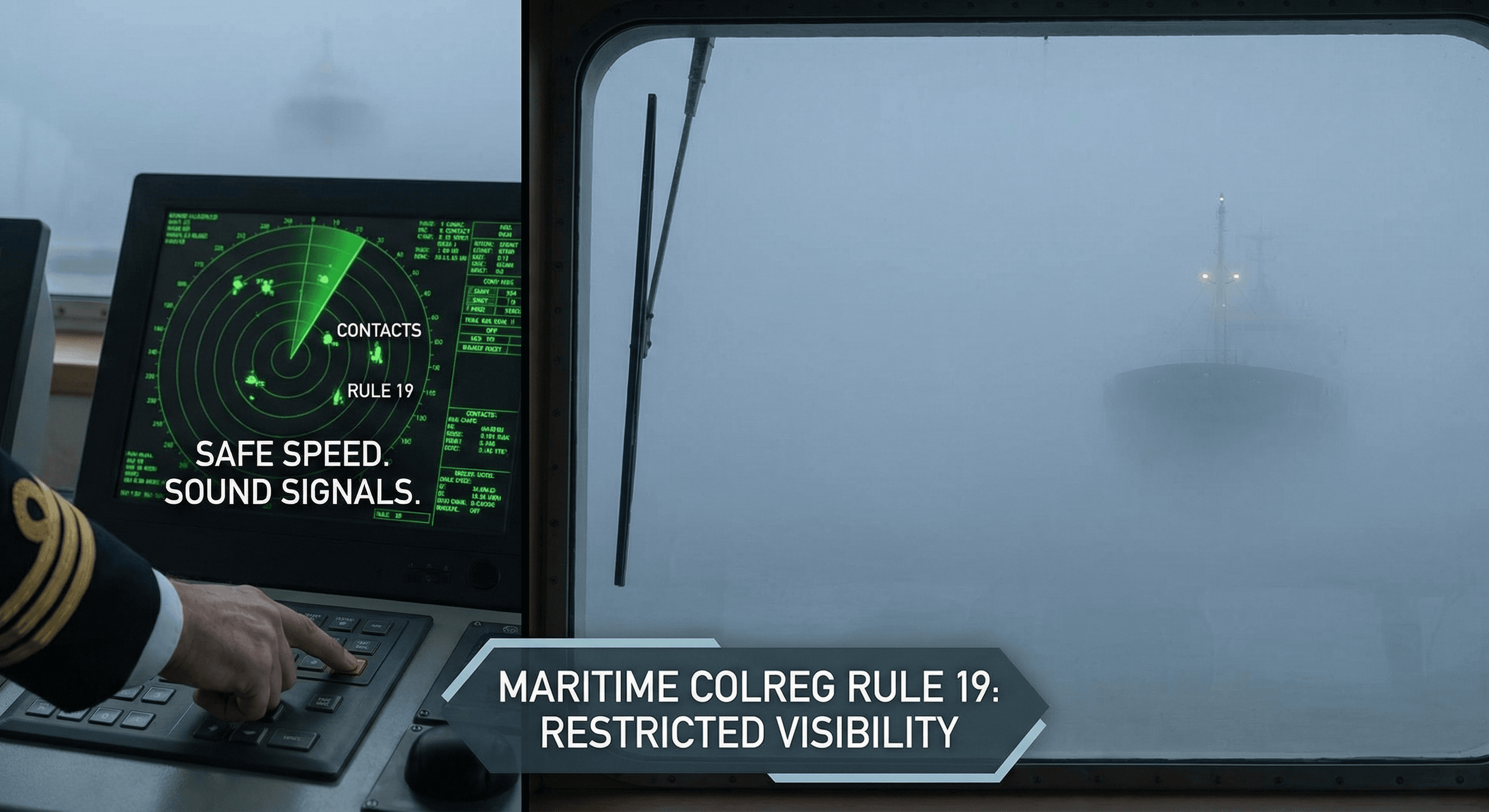
Rule 19: Conduct in restricted visibility
In restricted visibility without visual contact, navigate defensively with radar discipline and immediate readiness.
Detailed Explanation
(a) Applies when vessels are not in sight of one another in/near restricted visibility.
(b) Proceed at safe speed adapted to conditions; power-driven vessels keep engines ready for immediate manoeuvre.
(c) Apply Section I with due regard to restricted-visibility conditions.
(d) If detecting by radar alone, assess close-quarters/risk early and act in ample time. Avoid, as far as possible: (i) alteration to port for vessel forward of beam (except overtaken); (ii) alteration toward vessel abeam/abaft beam.
(e) Unless risk is determined absent: if fog signal is heard apparently forward of beam, or close-quarters forward of beam cannot be avoided, reduce to minimum speed for steerage, take all way off if needed, and navigate with extreme caution.
Key Points
- Applies when vessels are NOT in sight in restricted visibility
- Avoid altering to port for a vessel forward of the beam
- Avoid altering toward a vessel abeam or abaft the beam
- Speed must allow stopping within visible distance
Examples
- In dense fog you detect a radar target 4 miles ahead, 10° on your port bow. Rule 19(d)(i) prohibits altering to port for a vessel forward of your beam — you alter to starboard instead.
- Your engines are on standby as you navigate in restricted visibility. You hear a fog signal that appears to be forward of your beam but cannot localise it. Under Rule 19(e), you reduce to bare minimum steerage way.
- A container ship detects a vessel on radar abeam to starboard, range closing. Rule 19(d)(ii) advises against altering course toward a vessel abeam or abaft the beam; the ship reduces speed instead.
Common Mistakes
- Altering course to port for a vessel detected by radar forward of the beam.
- Failing to have engines ready for immediate manoeuvre in restricted visibility.
- Altering course towards a vessel abeam or abaft the beam, contrary to Rule 19(d)(ii).