3D Mark Viewer
3DEmergency wreck marking buoy
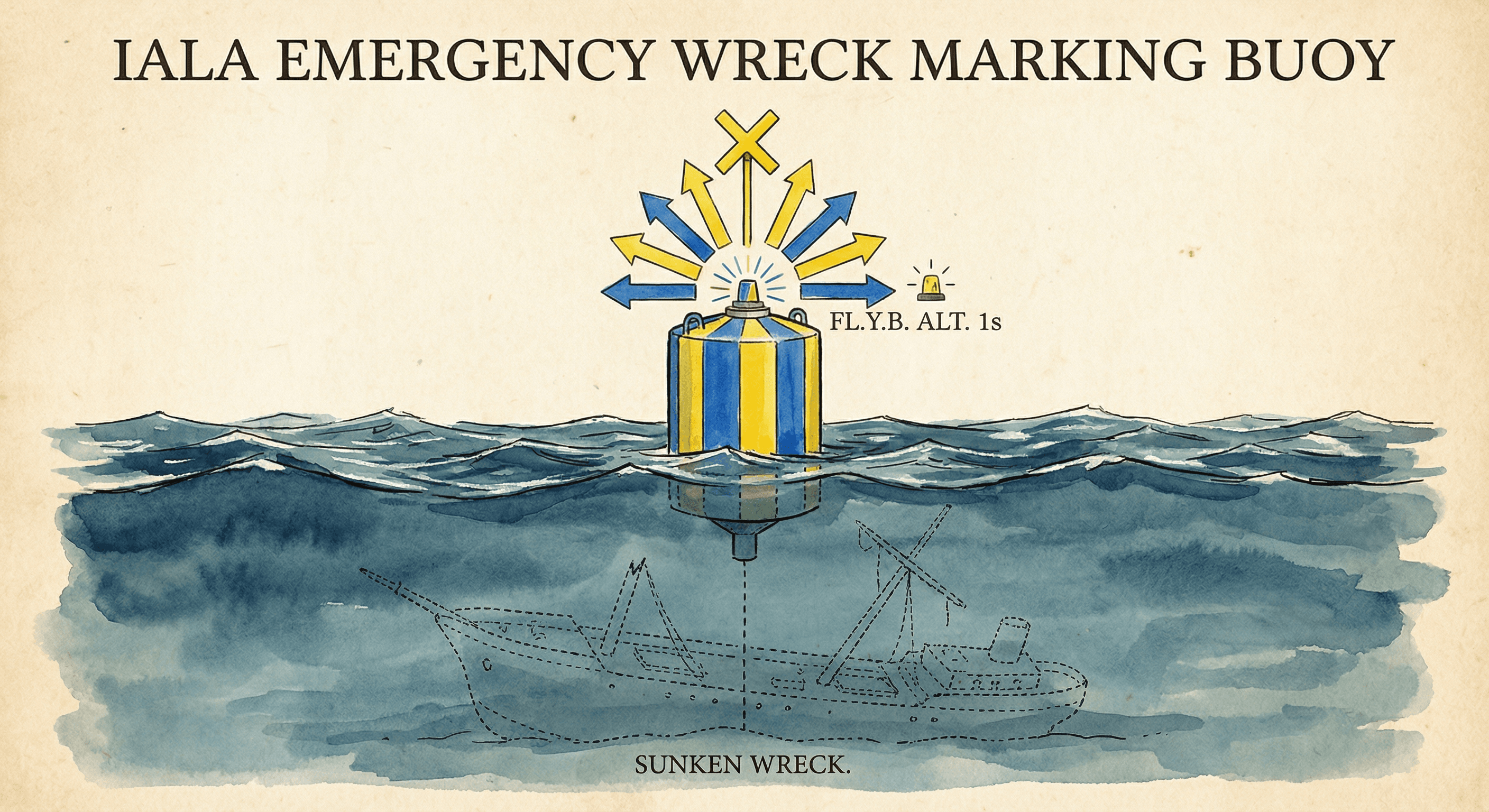
Emergency wreck marking buoys are deployed rapidly over new, uncharted wrecks to warn traffic. They are temporary and use a unique blue-yellow colour scheme with alternating flashing lights.
Detailed Explanation
Emergency wreck marking buoys are used for newly discovered wrecks not yet shown on charts:
- Colour: blue and yellow vertical stripes
- Topmark: standing/upright yellow cross
- Light: alternating blue and yellow, 1 second each (B 1s + Y 1s = 2s cycle)
- RACON: Morse 'D' (—··) if fitted
- AIS: may transmit as a virtual AIS AtoN
Deployment:
- Placed as close to the wreck as practicable
- Usually by the nearest coastal authority within hours of discovery
- Remains until the wreck is charted and conventional buoyage established
Key cautions:
- The exact extent of the wreck may NOT be fully surveyed
- Give generous clearance on all sides
- A second buoy may be placed on the opposite side of the wreck
- The mark is temporary — check Notices to Mariners for updates
Key Points
- Blue and yellow vertical stripes — unique colour scheme
- Alternating blue/yellow flashes (1s each)
- Temporary rapid-deployment mark for new wrecks
- Give wide berth — wreck extent may not yet be surveyed
Examples
- Approaching a recently reported wreck you see a buoy with blue and yellow vertical stripes and a yellow cross topmark. This is an emergency wreck marking buoy deployed to warn shipping until permanent marks are established.
- At night the emergency wreck buoy shows alternating blue and yellow flashes (1 second each). You give it a wide berth — the wreck's exact extent may not yet be fully surveyed.
Common Mistakes
- Confusing the blue-and-yellow vertical stripes of an emergency wreck buoy with a special mark's solid yellow colour.
- Assuming an emergency wreck buoy is permanent charted marking when it is a temporary rapid-deployment measure.
- Not giving sufficient clearance to an emergency wreck buoy because the wreck's exact extent may not yet be surveyed.