Rule 3: General definitions
Defines the vocabulary that decides which COLREG obligations apply in each encounter.
Detailed Explanation
This rule establishes the key terms used throughout COLREG:
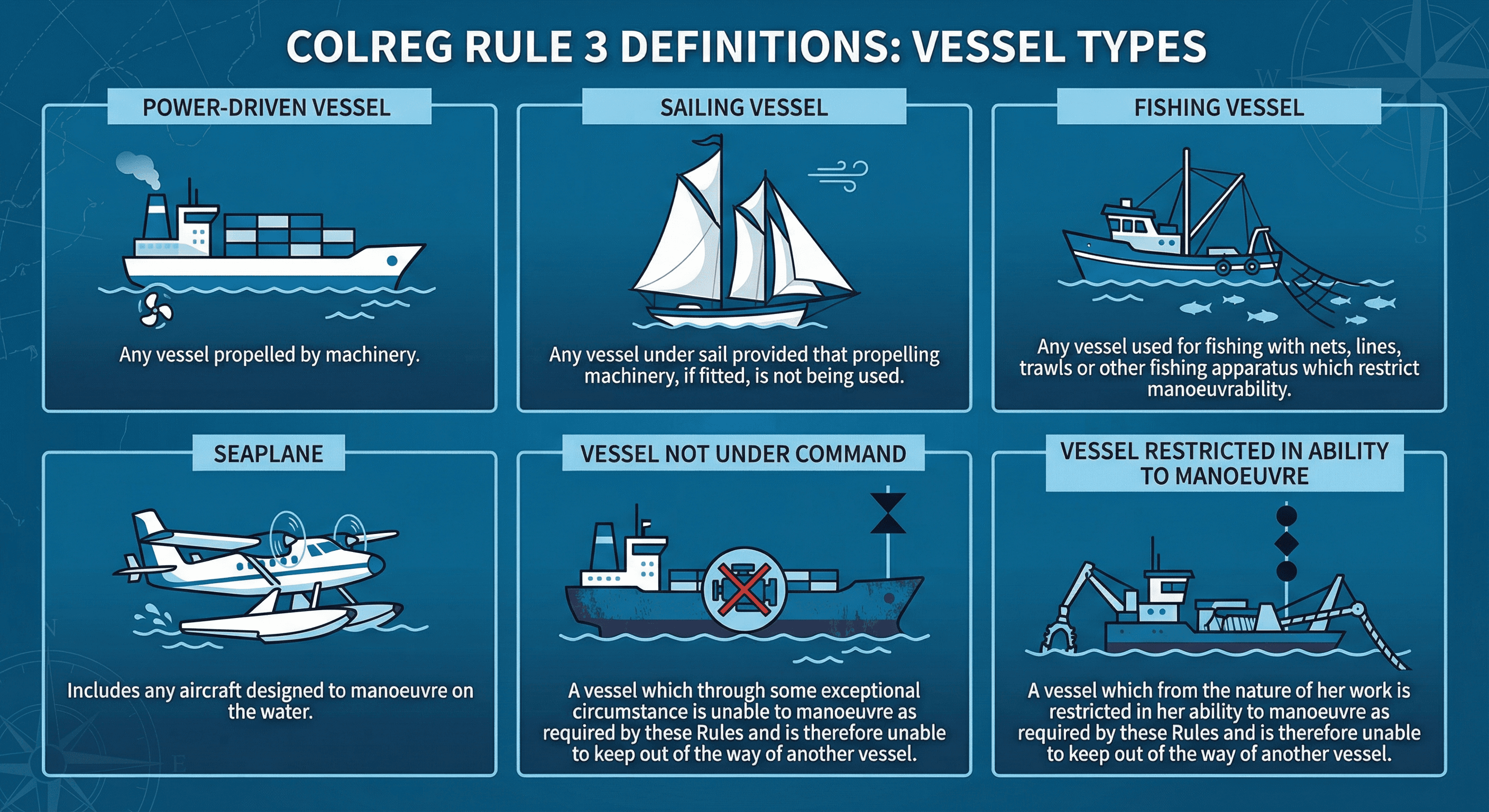
(a) Vessel — every kind of watercraft, including non-displacement craft, WIG craft and seaplanes, used/capable for transport on water.
(b) Power-driven vessel — any vessel propelled by machinery.
(c) Sailing vessel — under sail with propelling machinery, if fitted, not being used.
(d) Vessel engaged in fishing — fishing with gear that restricts manoeuvrability; trolling lines that do not restrict manoeuvrability are excluded.
(e) Seaplane — aircraft designed to manoeuvre on water.
(f) Not Under Command (NUC) — through exceptional circumstances, unable to manoeuvre as required and therefore unable to keep out of the way.
(g) Restricted in Ability to Manoeuvre (RAM) — restricted by nature of work. Includes, not limited to: (i) marks/cables/pipelines; (ii) dredging/survey/underwater ops; (iii) replenishment/transfer underway; (iv) aircraft launch/recovery; (v) mineclearance; (vi) towing severely restricting course deviation.
(h) Constrained by Draught (CBD) — a power-driven vessel severely restricted by draught relative to available depth/width.
(i) Underway — not at anchor, not made fast to shore, not aground.
(j) Length/Breadth — overall length and greatest breadth.
(k) In sight of one another — visual observation only.
(l) Restricted visibility — fog, mist, snow, heavy rain, sandstorms or similar causes.
(m) WIG craft — multimodal craft flying near surface using ground effect.
Key Points
- Definitions determine which rules apply to each vessel
- Sailing + engine = power-driven vessel
- NUC ≠ RAM: different obligations and priority
- Underway ≠ making way (vessel can be stopped but underway)
Examples
- A sailboat motoring with sails up is treated as power-driven for collision rules.
- A dredger displaying RAM signals is prioritized differently from an ordinary cargo vessel.
Common Mistakes
- Calling a vessel 'sailing' while its engine is propelling it.
- Confusing 'not under command' (NUC) with 'restricted in ability to manoeuvre' (RAM) and applying the wrong priority.
- Treating 'underway' as synonymous with 'making way' when a vessel can be underway but stopped through the water.